In this Sunday, Nov. 25, 2018 photo, Hindu hardliners, one holding a sword, chant slogans against Muslim communities during a rally demanding a Hindu temple be built on a site in northern India where hardliners in 1992 had attacked and demolished a 16th century mosque in Ayodhya Uttar Pradesh. Riots had left about 2,000 people dead. (AP Photo/Bernat Armangue)
The Associated Press
NEW DELHI (AP) - As she patrols for cow smugglers, Sadhvi Kamal, a Hindu holy woman in a saffron robe, rides in a white SUV with a sticker on the rear window displaying a cow framed by swords and rifles. The words in the sticker's logo say, "The cow is the mother of the world."
Kamal leads a vigilante force of thousands of volunteers, mostly young Hindu men. Such vigilante forces have emerged after several Indian states banned the slaughter of cows, sacred to Hindus, in recent years. Mobs have lynched three dozen Muslims, who traditionally run meat shops and slaughterhouses.
As India heads toward a general election that begins this week, taking up arms for "mother cow" is part of a broader campaign to impose ancient Hindu religious values across a multicultural country. As with similar movements across the world, Hindu nationalism, once fringe, has now taken a central place in India's politics.
The movement is led by the party of Prime Minister Narendra Modi, who grew up chanting slogans and practicing maneuvers at nationalist training camps. Modi and his Bharatiya Janata Party seek to retain power in the elections by promoting Hindutva - a Hindu way of life - instead of secular pluralism. A fresh mandate for Modi could embolden efforts to mold the world's largest democracy of 1.3 billion people into a stringently Hindu nation.
"I think what Modi has successfully done is just to normalize bigotry," said writer and historian Mukul Kesavan. "What we have already seen is a shift of the common sense of the republic way to the right."
Scenes of religious nationalism are now common in India.
In New Delhi and Ayodhya, a city in Uttar Pradesh state, tens of thousands of men in saffron armed with swords and the name of the Hindu Lord Ram painted on their foreheads shouted anti-Muslim epithets. They demanded a temple to Ram at a site where Hindu hardliners tore down a 16th century mosque in 1992, sparking riots that left about 2,000 people dead. Hindu groups say the mosque was only built after Muslim invaders destroyed a temple dedicated to Ram.
Elsewhere in Uttar Pradesh, the government spent unprecedented sums on the Hindu Kumbh Mela festival that ended last month, with Modi and the chief minister, Yogi Adityanath, himself a Hindu monk, appearing in countless posters. Three months earlier, Adityanath's state government replaced the Muslim name of the host city, Allahabad, with Prayagraj, a Sanskrit word from Hindu religious texts. The name change from Muslim to Hindu is one of many in recent months.
A Modi-appointed committee of scholars is also studying DNA samples to prove that today's Hindus are descendants of India's first inhabitants, and to establish that Hindu scriptures are fact and not myth.
Asked whether the Modi government is forcing Hinduism on its people, Abinav Prasoon, a spokesman for India's information ministry, said that "this is a political thing, and we cannot comment on it."
Even the Taj Mahal has not escaped the Hindu political agenda. Despite being a UNESCO world heritage site, the mausoleum built by Muslim Mughal emperor Shah Jahan was not included as a listed attraction by the Uttar Pradesh tourism ministry in 2017. Chief Minister Adityanath said foreign dignitaries should be gifted with the Bhagavad Gita, a Hindu religious text, instead of a replica of the monument.
The cow has become a symbol of this growing nationalism.
About 280 people were injured in more than 100 attacks by vigilantes between May 2015 and December 2018, Human Rights Watch said in a recent report. Kamal's group has been involved in some of the most gruesome assaults on suspected cow smugglers.
"Violence is wrong but if the matter involves protecting a mother, all is fair," Kamal said.
At least two men involved in assaulting suspected cow smugglers are also candidates in the upcoming parliamentary polls. Even the opposition Congress party, long associated with the secularism of its co-founder and India's first prime minister Jawaharlal Nehru, has pushed to protect cows. In Congress-controlled Madhya Pradesh state, authorities jailed two men suspected of illegally transporting cows under the National Security Act, which allows for detention in cases of threats to state security.
As Brahma Chellaney, a professor of strategic studies at the New Delhi-based Center for Policy Research, put it: "While the U.S. is ruled by cowboys, India is ruled by cowmen."
Cowwomen, too, it seems.
In this Tuesday, Jan. 15, 2019 photo, Hindus gather for a spiritual cleansing dip at Sangam, the confluence of the rivers Ganges, Yamuna and mythical Saraswati, during the Kumbh Mela festival in Prayagraj, India. (AP Photo/Bernat Armangue)
The Associated Press
In this Sunday, Nov. 25, 2018 photo, a Hindu hardline supporter wears the the name of the god Ram written on his forehead in Ayodhya, Uttar Pradesh, India. Tens of thousands rallied to demand a Hindu temple be built on a site in northern India where hardliners in 1992 had attacked and demolished a 16th century mosque, sparking deadly Hindu-Muslim violence. Hindu groups say the mosque was built after a temple dedicated to Ram was destroyed by Muslim invaders. (AP Photo/Bernat Armangue)
The Associated Press
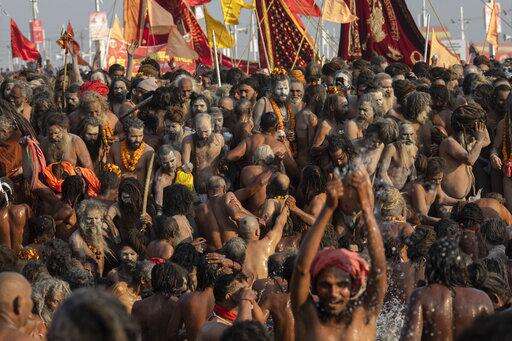
In this Tuesday, Jan. 15, 2019 photo, sadhus, Hindu holy men, take a holy dip at Sangam, the confluence of the rivers Ganges, Yamuna and mythical Saraswati, during the Kumbh Mela festival in Prayagraj, India. The city's Mughal-era name Allahabad was recently changed to Prayagraj by the Hindu nationalist government. The historic city name referred to Muslim Mughal rulers during the 16th century. The new name refers to the confluence of the rivers Ganges, Yamuna and mythical Saraswati, the site of the Hindu Kumbh Mela festival. (AP Photo/Bernat Armangue)
The Associated Press
In this Sunday, Dec. 9, 2018 photo, a supporter of the Hindu nationalist political group Vishwa Hindu Parishad is dressed as the Hindu deity Hanuman during a rally in New Delhi, India. Tens of thousands of worshippers gathered in India's capital to demand construction of a Hindu temple on the ruins of a disputed 16th century mosque in northern Indian city of Ayodhya. (AP Photo/Bernat Armangue)
The Associated Press
In this Tuesday, Jan. 15, 2019 photo, a sadhu, a Hindu holy man, pours water from a shell as he takes a ceremonial cleansing dip at Sangam, the confluence of the rivers Ganges, Yamuna and mythical Saraswati, during the Kumbh Mela festival in Prayagraj, India. (AP Photo/Bernat Armangue)
The Associated Press
In this Sunday, Nov. 25, 2018 photo, a Hindu hardline supporter applies saffron to his forehead in Ayodhya, Uttar Pradesh, India. As with similar movements across the world, Hindu nationalism, once fringe, has now taken a central place in Indiaâs politics. (AP Photo/Bernat Armangue)
The Associated Press
In this Wednesday, Dec. 12, 2018 photo, Hindu students of the Baghambari Math Gaddi have lunch in Prayagraj, India. As with similar movements across the world, Hindu nationalism, once fringe, has now taken a central place in Indiaâs politics. (AP Photo/Bernat Armangue)
The Associated Press
In this Sunday, Nov. 25, 2018 photo, a man holds a brick reading "Jai Shree Ram" (Victory to Lord Ram) as bricks of the old Babri Mosque are piled up in Ayodhya Uttar Pradesh, India. (AP Photo/Bernat Armangue)
The Associated Press
In this Sunday, Nov. 25, 2018 photo, Hindu hardliners gather next to building materials to be assembled in a temple dedicated to Hindu god Ram in Ayodhya, Uttar Pradesh, India. (AP Photo/Bernat Armangue)
The Associated Press
In this Tuesday, Dec. 11, 2018 photo, members of the Rashtriya Swayamsevak Sangh (RSS) gather during an early morning shakha, a daily training, in Prayagraj, India. (AP Photo/Bernat Armangue)
The Associated Press
In this Sunday, Nov. 25, 2018 photo, Hindu hardliners visit a memorial dedicated to the Kothari brothers and other Hindus killed during riots in Ayodhya, Uttar Pradesh, India. (AP Photo/Bernat Armangue)
The Associated Press
In this Monday, Nov. 26, 2018 photo, moviegoers stand as national anthem is played at a cinema before the screening of a movie in Lucknow, Uttar Pradesh, India. As with similar movements across the world, Hindu nationalism, once fringe, has now taken a central place in Indiaâs politics. (AP Photo/Bernat Armangue)
The Associated Press
In this Tuesday, Dec. 4, 2018 photo, relatives cry next to the body of police Inspector Subodh Kumar Singh in Chingarwathi, near Bulandshahr, in the northern Indian state of Uttar Pradesh. The previous day, Singh and another person were killed in the mob violence that began with accusations of cow slaughter in the area. (AP Photo/Bernat Armangue)
The Associated Press
This Tuesday, Dec. 4, 2018 photo shows vandalized cars and other vehicles in Chingarwathi, near Bulandshahr, in the northern Indian state of Uttar Pradesh. The previous day, two people were killed in mob violence that began with accusations of cow slaughter in the area. About 280 people were injured in more than 100 attacks by vigilantes between May 2015 and December 2018, Human Rights Watch said in a recent report. (AP Photo/Bernat Armangue)
The Associated Press
In this Friday, Jan. 25, 2019 photo, Hindu holy woman Sadhvi Kamal, 40, talks on the phone with members of her vigilante network in front Indian muslim cattle traders on the outskirts of Jaipur, Rajasthan, India. Thousands of volunteers, mostly young Hindu men from India's desert state of Rajasthan, disguise themselves by growing beards, wearing short, rounded skullcaps, and using Muslim names to infiltrate illegal cow smuggling operations. (AP Photo/Bernat Armangue)
The Associated Press
In this Monday, Jan. 14, 2018 photo, people stand near a poster of Prime Minister Narendra Modi during the Kumbh Mela festival in Allahabad, India. The government spent unprecedented sums on the heavily-attended Hindu Kumbh Mela festival, with Modi and the chief minister, Yogi Adityanath, himself a Hindu monk, appearing in countless posters. (AP Photo/Bernat Armangue)
The Associated Press
In this Sunday, Dec. 9, 2018 photo, a supporter of Hindu-extreme political group Vishwa Hindu Parishad wears a poster of the Hindu god Ram during a rally in New Delhi, India. (AP Photo/Bernat Armangue)
The Associated Press
In this Wednesday, Jan. 23, 2019 photo, Taj Mahal postcards are displayed in a souvenir shop in Agra, India. Despite being a UNESCO world heritage site, the mausoleum built by Muslim Mughal emperor Shah Jahan was not included as a listed attraction by the Uttar Pradesh tourism ministry in 2017. Chief minister Adityanath said foreign dignitaries should be gifted with the Bhagavad Gita, a Hindu religious text, instead of a replica of the monument. (AP Photo/Bernat Armangue)
The Associated Press
In this Wednesday, Dec. 12, 2018 photo, cows rest in a barn at Baghambari Math Gaddi in Prayagraj, India. Cows are considered sacred in Hindu-majority India, and slaughtering them or eating beef is illegal or restricted across much of the country. (AP Photo/Bernat Armangue)
The Associated Press
In this Monday, Nov. 26, 2018 photo, Muslims selling meat wait for customers in Lucknow, Uttar Pradesh, India. Since Indian Prime Minister Narendra Modi's nationalist Bharatiya Janata Party-led government came to power in 2014, several Indian states have banned the slaughter of cows, sacred to Hindus, giving rise to vigilantes and dozens of lynchings of Muslims, a minority group who have traditionally run meat shops and slaughterhouses. (AP Photo/Bernat Armangue)
The Associated Press
In this Friday, Jan. 25, 2019 photo, Muslim cattle traders load buffaloes into a pickup after being challenged by cow vigilantes on the outskirts of Jaipur, Rajasthan, India. (AP Photo/Bernat Armangue)
The Associated Press
In this Tuesday, Jan. 22, 2019 photo, a man holds a phone showing a video of Muslim farmer Saghir Khan, 25, moments after being beaten, Mirzapur, India. Most of the attacks by so-called cow vigilantes from Hindu groups have targeted Muslims, who make up 14 percent of India's 1.3 billion people. Hindus make up about 80 percent of the population. (AP Photo/Bernat Armangue)
The Associated Press
In this Tuesday, Jan. 22, 2019 photo, the wife of Saghir Khan,Anisa Khan, holds their daughter, Alfisa, at the family's house in Mirzapur. Saghir was beaten by a group of Hindus after being spotted transporting cows. (AP Photo/Bernat Armangue)
The Associated Press
This Wednesday, Dec. 12, 2018 photo shows a dilapidated and closed slaughter house in Prayagraj, India. Since Indian Prime Minister Narendra Modi's nationalist Bharatiya Janata Party-led government came to power in 2014, several Indian states have banned the slaughter of cows, sacred to Hindus, giving rise to vigilantes and dozens of lynchings of Muslims, a minority group who have traditionally run meat shops and slaughterhouses. (AP Photo/Bernat Armangue)
The Associated Press