A migrant carries a Mexican and Honduran flag atop a tanker truck as a thousands-strong caravan of Central Americans hoping to reach the U.S. border moves onward from Juchitan, Oaxaca state, Mexico, Thursday, Nov. 1, 2018. Police outside Juchitan were stopping tankers and some other trucks and making migrants climb down and walk, as thousands of migrants resumed their slow trek through southern Mexico on Thursday, after attempts to obtain bus transport to Mexico City failed. (AP Photo/Rebecca Blackwell)
The Associated Press
JUCHITAN, Mexico (AP) - Thousands of Central American migrants resumed their slow trek through southern Mexico on Thursday, as immigration agents and police nibbled at the edges of the two caravans currently in the country.
Mexican authorities haven't directly targeted the main caravan of about 4,000 migrants, and activists aiding that group said they were shifting their route toward the Gulf coast, a path closer to the Texas border.
But a second, smaller caravan about 200 miles behind the first group appeared to be more leaderless, get less press attention and be more vulnerable.
A federal official who was not authorized to be quoted by name said 153 migrants in the second caravan were detained Wednesday during highway inspections in the southern state of Chiapas, a short distance from the Guatemalan border. While the precise size of the second caravan is unclear, that could be equivalent to about 10 percent of those participating.
And there was also pressure on the first caravan, which set out before dawn Thursday from Juchitan, Oaxaca, seeking to reach the town of Matias Romero, about 40 miles (65 kilometers) ahead.
They had tried to arrange bus transport from Juchitan, but failed, leaving them once again on foot, hitch-hiking and looking for rides where they can find them.
But federal police began pulling freight trucks over and forcing migrants off, saying their habit of clinging to the tops or sides of the trucks was dangerous.
"Get off! Get off!" police officer Benjamin Grajeda shouted to a group of migrants clinging to the side of a truck outside Juchitan. "You can ride inside, but not on the outside."
At other points along the route, police have forced overloaded pickups to disgorge migrants. On previous days, they have ordered passenger vans to stop transporting migrants.
The migrants have not said what route they intend to take northward or where on the U.S. border they planned to reach.
While Matias Romero would take them toward the Gulf coast city of Veracruz and a route toward the Texas border, another large caravan early this year passed through Veracruz and then veered back toward Mexico City and eventually tried to head to Tijuana in the far northwest. Few made it.
In Matias Romero, the migrants complained of bad smells and snakes in the area where they were told to camp overnight at the entrance to the town. Local authorities told them they couldn't occupy the main square because of Day of the Dead events to be held there.
Late Thursday, the migrants decided to leave at 5 a.m. Friday toward Veracruz, with their destination either Donaji or Sayula de Aleman.
White House press secretary Sarah Huckabee Sanders on Wednesday praised Mexico for stopping the migrants from getting rides.
"Mexico has stepped up in an unprecedented way," Sanders told Fox News. "They have helped stop a lot of the transportation means of these individuals in these caravans, forcing them walking. They have helped us in new ways to slow this down, to break this up and keep it from moving as aggressively toward the United States."
But U.S. President Donald Trump ramped up his pre-election focus on the caravan and others behind it, talking of creating a U.S. military force on the border that would outnumber the migrants, many of them women and children.
"As far as the caravan is concerned, our military is out," Trump said. "We have about 5,800. We'll go up to anywhere between 10,000 and 15,000 military personnel on top of Border Patrol, ICE and everybody else at the border."
Later Wednesday, Trump told ABC News, "We have to have a wall of people."
A third band of about 500 from El Salvador made it to Guatemala, and a fourth group of about 700 set out from the Salvadoran capital Wednesday.
Altogether, the four caravans represent just a few days' worth of the average flow of migrants to the United States in recent years.
Similar caravans have occurred regularly over the years and passed largely unnoticed, but Trump has focused on the latest marchers seeking to make border security a hot-button issue in next week's midterm elections.
Worn down by days of long walks, many migrants have dropped out and returned home or applied for protected status in Mexico. The Interior Department said Thursday that the number of migrants who have applied for refuge was now nearly 3,000.
The initial caravan has shrunk significantly from its estimated peak of more than 7,000 migrants. A caravan last the spring ultimately fizzled to just about 200 people who reached the U.S. border at San Diego.
On Wednesday, a Guatemalan woman gave birth to the first known caravan baby at a hospital in Juchitan. Mexico's governmental National Human Rights Commission said it had arranged for medical attention for the woman, who was 28 weeks pregnant, and the girl was healthy.
___
Associated Press writer Peter Orsi in Mexico City contributed to this report.
A migrants from El Salvador wait to be attended by Salvadoran migration authorities in La Hachadura, El Salvador, Wednesday, Oct. 31, 2018. A fourth group of about 700 Salvadorans set out from the capital, San Salvador, with plans to walk to the U.S. border, 1,500 miles away. (AP Photo/Diana Ulloa)
The Associated Press
Migrants hitch rides in the back of trucks as the thousands-strong caravan of Central Americans hoping to reach the U.S. border moves onward from Juchitan, Oaxaca state, Mexico, Thursday, Nov. 1, 2018. Thousands of migrants resumed their slow trek through southern Mexico on Thursday, after attempts to obtain bus transport to Mexico City failed. (AP Photo/Rebecca Blackwell)
The Associated Press
A migrant carrying the flags of Mexico and Honduras gives a thumbs-up to a moto rickshaw driver who stopped to take their picture, as a thousands-strong caravan of Central Americans hoping to reach the U.S. border moves onward from Juchitan, Oaxaca state, Mexico, Thursday, Nov. 1, 2018. Thousands of migrants resumed their slow trek through southern Mexico on Thursday, after attempts to obtain bus transport to Mexico City failed. (AP Photo/Rebecca Blackwell)
The Associated Press
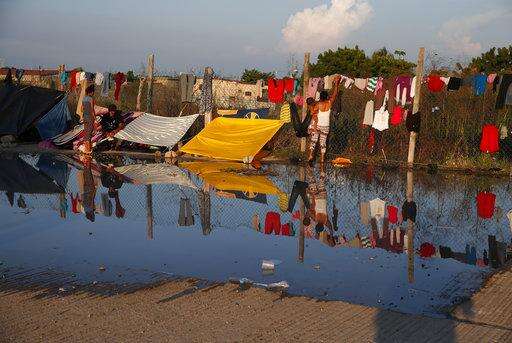
Water is left behind after migrants took showers with donated water brought in by truck, in an area where migrants are camping and doing laundry, as a thousands-strong caravan of Central Americans hoping to reach the U.S. border takes a rest day in Juchitan, Oaxaca state, Mexico, Wednesday, Oct. 31, 2018. Thousands of weary Central American migrants in a caravan rested Wednesday in southern Mexico while their representatives tried to negotiate transportation hundreds of miles ahead to the capital, but by evening there was bad news: they'd be walking again the next day. (AP Photo/Rebecca Blackwell)
The Associated Press
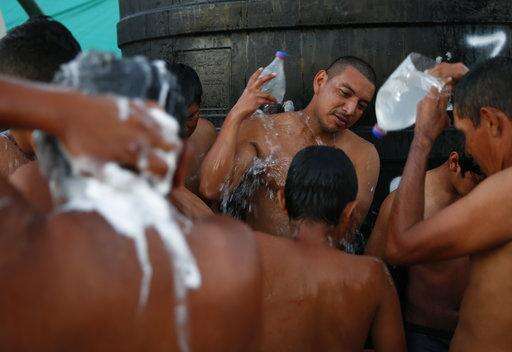
Central American migrants bathe in donated water brought in on trucks, as a thousands-strong caravan of Central Americans hoping to reach the U.S. border take a rest day in Juchitan, Oaxaca state, Mexico, Wednesday, Oct. 31, 2018. Thousands of weary Central American migrants in a caravan rested Wednesday in southern Mexico while their representatives tried to negotiate transportation hundreds of miles ahead to the capital, but by evening there was bad news: they'd be walking again the next day. (AP Photo/Rebecca Blackwell)
The Associated Press
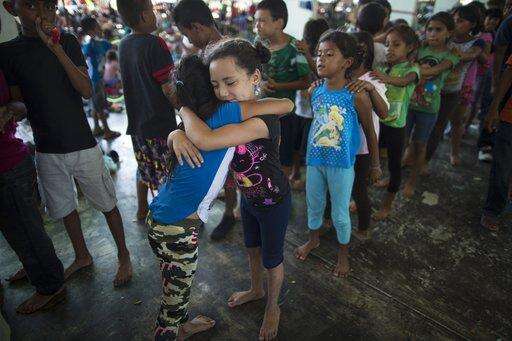
Honduran girls hug while waiting in line for a chance to play on the playground at a camp set up by a caravan of thousands of Central American migrants in Juchitan, Mexico, Wednesday, Oct. 31, 2018. Representatives of the group sought Wednesday to negotiate use of dozens of buses to carry the migrants hundreds of miles ahead, as the caravan took at least a day off from the grind of walking and hitching rides in packed trucks from small town to small town. (AP Photo/Rodrigo Abd)
The Associated Press
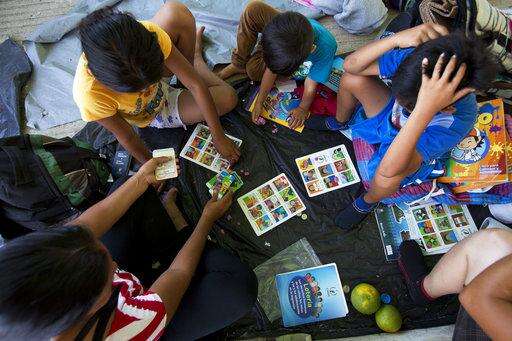
Children play a bingo game given to them by Mexico's human rights organization, that teaches them about the rights of migrant children, as a thousands-strong caravan of Central Americans hoping to reach the U.S. border takes a rest day in Juchitan, Oaxaca state, Mexico, Wednesday, Oct. 31, 2018. Thousands of weary Central American migrants in a caravan rested Wednesday in southern Mexico while their representatives tried to negotiate transportation hundreds of miles ahead to the capital, but by evening there was bad news: they'd be walking again the next day. (AP Photo/Rebecca Blackwell)
The Associated Press
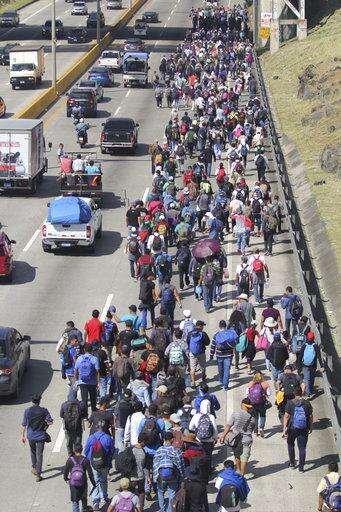
Migrants from El Salvador start on their way to the United States, in San Salvador, El Salvador, Wednesday, Oct. 31, 2018. A third group of migrants from El Salvador had already made it to Guatemala, and on Wednesday a fourth group of about 700 Salvadorans set out from the capital, San Salvador, with plans to walk to the U.S. border, 1,500 miles away. (AP Photo/Diana Ulloa)
The Associated Press
One migrant family with a baby hires a motorized rickshaw taxi back to town in order to buy bus tickets to travel to the next stop, after failing to hitch hike for free as a thousands-strong caravan of Central Americans moves onward from Juchitan, Oaxaca state, Mexico, Thursday, Nov. 1, 2018. Thousands of migrants resumed their slow trek through southern Mexico on Thursday, after attempts to obtain bus transport to Mexico City failed. (AP Photo/Rebecca Blackwell)
The Associated Press
Migrants board a stopped truck in hopes the driver will agree to carry them, as a thousands-strong caravan of Central Americans hoping to reach the U.S. border moves onward from Juchitan, Oaxaca state, Mexico, Thursday, Nov. 1, 2018. Thousands of migrants resumed their slow trek through southern Mexico on Thursday, after attempts to obtain bus transport to Mexico City failed. (AP Photo/Rebecca Blackwell)
The Associated Press
A mother embraces her daughter as they wait for a ride on the side of the road along with other Central Americans, outside Juchitan, Oaxaca state, Mexico, Thursday, Nov. 1, 2018. Thousands of migrants resumed their slow trek through southern Mexico on Thursday, after attempts to obtain bus transport to Mexico City failed. (AP Photo/Rebecca Blackwell)
The Associated Press