In this Jan. 30, 2017 photo, an anti-narcotics police officer inspect flowers at the El Dorado Airport, in Bogota, Colombia. Security protocols developed by the flower industry with police begin from the moment refrigerated trucks carrying rose buds depart the flower farms. Once inside the airport, police offices equipped with drug-sniffing dogs and electronic scanners inspect each shipment. (AP Photo/Fernando Vergara)
The Associated Press
BOGOTA, Colombia (AP) - Cocaine is probably the last thing most people think about when buying roses.
But every year, police and growers in Colombia must work around the clock to make sure that the romance of Valentine's Day isn't spoiled by the drug, the nation's other major export along with flowers.
As much as 330,000 pounds (150 metric ton)s of flowers leave Colombia on 30-plus jumbo cargo planes daily starting in late January, presenting an opportunity for the country's ingenious drug cartels to penetrate the frenzied, overworked chain of suppliers and stash drugs amid the roses.
"Without a doubt we're a target," said Augusto Solano, president of the Colombian flower exporters' association.
Security protocols that the flower industry developed with police begin the moment that refrigerated trucks carrying rose buds depart dozens of flower farms dotting the waterlogged savannah surrounding Colombia's capital. Once the flowers are inside the airport, 100 police offices equipped with 15 drug-sniffing dogs and electronic scanners inspect each shipment.
Last year, police said they found almost 200 pounds (90 kilograms) of cocaine hidden in flower boxes.
"We have to guarantee that our flower exports aren't contaminated by criminal gangs," Col. Julio Triana said as he and his drug-sniffing Labrador retriever walked through the refrigerated warehouse where flowers are kept before being loaded onto cargo planes.
Colombia's flower industry took off in the early 1990s when the U.S. Congress passed a law eliminating tariffs on goods from Andean drug-producing nations in a bid to encourage legal exports. That Colombia's criminals now train their eyes on flower shipments as a way to smuggle drugs into the U.S. is a sign of just how much the industry has blossomed. It is now is the world's second-largest cut flower exporter, after the Netherlands, and the top supplier to the U.S.
The season before Valentine's Day is the busiest time of the year for Colombia's growers, when the 130,000 people employed at hundreds of flower farms work nonstop to ship some 500 million stems, mostly to the United States but other parts of the world as well.
"Right now there's not a single rose available," said Solano.
But with competitors from Kenya and Ecuador making inroads, the industry isn't taking its leadership for granted and works hard to keep out smuggled drugs.
"It requires a big effort because if another country finds drugs they can ban flower imports from Colombia and that would be disastrous," Solano said.
___
Associated Press writer Alba Tobella contributed to this report.
In this Jan. 20, 2017 photo, a worker harvests rosebuds to be shipped to the United States ahead of Valentine's Day, at the Ayura flower company in Tocancipa, north of Bogota, Colombia. Every year police and flower growers in Colombia work around the clock to make sure that the romance of Valentine's Day isn't spoiled by the nation's other major export: cocaine. (AP Photo/Fernando Vergara)
The Associated Press
In this Jan. 20, 2017 photo, workers pack roses to be shipped to the United States ahead of Valentine's Day, at the Ayura flower company in Tocancipa, north of Bogota, Colombia. As many as 150 metric tons of flowers have been leaving Colombia on jumbo cargo planes every day since late January. (AP Photo/Fernando Vergara)
The Associated Press
In this Jan. 20, 2017 photo, a worker packs rose buds to be shipped to the United States ahead of Valentine's Day, at the Ayura flower company in Tocancipa, north of Bogota, Colombia. The country's flower industry took off in the early 1990s when the U.S. Congress passed a law eliminating tariffs on goods from Andean drug-producing nations in a bid to encourage legal exports instead. (AP Photo/Fernando Vergara)
The Associated Press
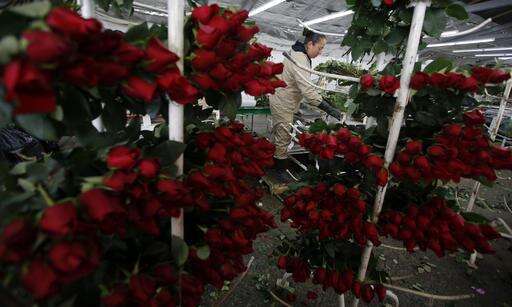
In this Jan. 20, 2017 photo, a worker packs rose buds to be shipped to the United States ahead of Valentine's Day, at the Ayura flower company in Tocancipa, north of Bogota, Colombia. This is the busiest time of the year for the country's flower industry, when thousands of people employed at hundreds of flower farms work nonstop to deliver some 500 million stems around the world but principally the U.S. "Right now there's not a single rose available," said Augusto Solano, president of Colombia's flower exporters association. (AP Photo/Fernando Vergara)
The Associated Press
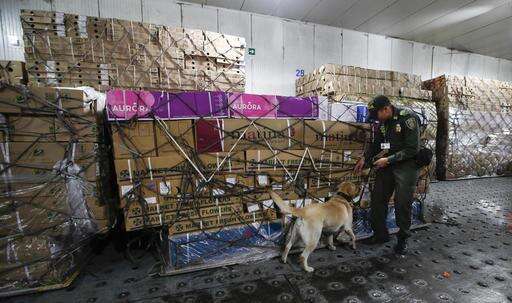
In this Jan. 30, 2017 photo, a drug-sniffing police dog inspects boxes containing flowers at the El Dorado Airport before to be shipped to the US ahead of Valentine's Day, in Bogota, Colombia. The effort isn't in vain: last year, police said they found nearly 90 kilograms of cocaine hidden in flower boxes, much of it likely placed there by shadowy mafias who've penetrated the supply chain. (AP Photo/Fernando Vergara)
The Associated Press
In this Jan. 20, 2017 photo, a worker carries a few dozen rose buds harvested at the Ayura flower company in Tocancipa, north of Bogota, Colombia. Colombia is the world's second-largest cut flower exporter, after the Netherlands, and the top supplier to the United States. (AP Photo/Fernando Vergara)
The Associated Press
In this Jan. 20, 2017 photo, a worker holds a spray of yellow roses to be shipped to the United States ahead of Valentine's Day, at the Ayura flower company in Tocancipa, north of Bogota, Colombia. Every year police and flower growers in Colombia work around the clock to make sure that the romance of Valentine's Day isn't spoiled by the nation's other major export: cocaine. (AP Photo/Fernando Vergara)
The Associated Press
In this Jan. 26, 2017 photo, a worker carries packaged rosebuds to be shipped to the United States ahead of Valentine's Day, at the Unique Collection flower company in Sopo, near Bogota, Colombia. Colombia is the world's second-largest cut flower exporter, after the Netherlands, and the top supplier to the United States. (AP Photo/Fernando Vergara)
The Associated Press