In this Oct. 7, 2016 photo, Abdullah Khal, whose father, Mohammad Ali Hadish Khal, was killed by a Saudi-led airstrike that targeted his car at Abs hospital in August, poses during an interview with The Associated Press, in the northern town of Abs, Yemen. In the air campaign by Saudi Arabia and its allies against Yemenâs Shiite rebels, rights experts say there has been a pattern by the Saudi-led coalition in depending on faulty intelligence, failing to distinguish between civilian and military targets and disregarding the likelihood of civilian casualties. Experts say some of the strikes likely amount to war crimes. (AP Photo/Hani Mohammed)
The Associated Press
ABS, Yemen (AP) - On an August morning, a taxi driver in northwestern Yemen hugged his kids and jokingly told his family, "Forgive me if I don't come back." It was his way of laughing off the danger of driving in a country where airstrikes can hit any road at any time.
In the afternoon, Mohammed al-Khal happened upon just such a strike. Three missiles had hit a highway, leaving bystanders wounded. Al-Khal took one of them, an ice cream vendor, in his car and rushed him to the nearest hospital, run by the international humanitarian group Doctors Without Borders.
But the warplanes were still hunting.
Moments after al-Khal pulled up at the hospital in the town of Abs, a missile smashed down by his car, just outside the hospital entrance. Al-Khal, a father of eight, was incinerated. The blast ripped through patients and family waiting in an outdoor reception area. Nineteen people were killed, along with two civilians killed on the highway.
The Aug. 15 attack typified what has been a pattern in the nearly 2-year-old air campaign by Saudi Arabia and its allies against Yemen's Shiite rebels, known as Houthis. Rights groups and U.N. officials say the U.S.-backed coalition has often either deliberately or recklessly depended on faulty intelligence, failed to distinguish between civilian and military targets and disregarded the likelihood of civilian casualties.
Experts say some of the strikes amount to war crimes.
"The Saudis have been committing war crimes in Yemen," said Gabor Rona, a professor teaching the laws of war at Columbia University. He warned that American personnel helping the coalition "may also be guilty of war crimes."
Nearly 4,000 civilians have been killed in the war, and an estimated 60 percent of them died in airstrikes by the Saudi-led coalition, the U.N. says.
Saudi Arabia launched the coalition campaign in March 2015 in a bid to restore the internationally recognized government of President Abed Rabbo Mansour Hadi, after the Houthis overran the capital, Sanaa, and the north of the country. The Iranian-backed Houthis are allied with troops loyal to Hadi's ousted predecessor, Ali Abdullah Saleh.
The war has devastated the country of 26 million, causing widespread hunger and driving 3 million from their homes.
Warplanes have hit medical centers, schools, factories, infrastructure and roads, markets, weddings and residential compounds.
The U.S. and its allies have sold billions of dollars in weapons to Saudi Arabia for the campaign. The U.S. military provides it with intelligence, satellite imagery and logistical help.
Washington underlines it does not make targeting decisions and calls on the coalition to investigate reported violations. Over the summer, the U.S military reduced the number of military personnel advising the coalition from several dozen to fewer than five, an apparent move to distance itself from the campaign.
"U.S. security cooperation with Saudi Arabia is not a blank check," National Security Council spokesman Ned Price said.
The coalition says it does its utmost to avoid civilian casualties and notes rebels often operate among civilians. Rights groups and U.N. officials have reported probable war crimes by the Houthis, including shelling civilian areas and basing their fighters in schools and other civilian locations.
"This is the fog of war," the coalition's spokesman, Saudi Gen. Ahmed al-Asiri, told The Associated Press when asked if there is a pattern of civilian deaths. "In war, there are decisions that should be taken fast."
The coalition, which says it investigates every claim of violations, has made nine investigations public. In two it acknowledged mistakes and said it would pay compensation to victims. In most of the other cases, it said the strikes were against a justified military target.
But critics say the American and international backing has given Saudi Arabia and its allies a free rein.
"We believe that the coalition understood ... it has a green light to commit more massacres in Yemen," said Abdel-Rashed al-Faqeh, the head of Muwatana, one of Yemen's most prominent rights groups.
The strike in Abs underscored several of the problems experts point to in many strikes - the failure to distinguish between civilian and military targets and a lack of proportionality, the principle that use of force must be balanced to avoid civilian casualties.
In the strikes, warplanes initially fired a rocket targeting a Houthi checkpoint manned by two rebels on a highway outside Abs. The fighters escaped, but two more rockets were fired, killing two bystanders and wounding others. It appears the warplanes followed al-Khal's Camry, believing he was carrying a wounded fighter, and struck him outside the hospital.
The hospital was on a coalition list of sites not to be targeted in airstrikes, and had markings on its roof to show it was a medical facility.
The AP interviewed witnesses to the strikes on the highway and at the hospital, as well as al-Khal's two wives.
The head of Doctors Without Border's mission in Yemen, Colette Gadenne, said the coalition acknowledged to the group privately that the strike was a mistake.
The head of the coalition's investigation team, Mansour al-Mansour, said he could not discuss the investigation results in public. He said the coalition gave Doctors Without Borders all information it gathered.
The effect of the strike - the fifth on a facility run by the group in Yemen - has been wide-reaching. The organization pulled its personnel from northern Yemen, straining staff at multiple hospitals.
The Abs hospital served around 100,000 peoplpe, said its manager, Ibrahim Ali. Now it is shut down and the nearest medical facilities are two or three hours away by car. "Patients sometimes die on the road," Ali said.
Rona, the legal expert, said those behind the Abs strikes "didn't take sufficient precautions to determine that the people in the taxi are targetable." Then, warplanes struck where "there would be significant collateral damage to the hospital."
"Any way you look at it, it is a war crime."
__
Al-Haj reported from Sanaa, AP journalists Maad al-Zikry and Hani Mohammed contributed to this report from Yemen.
In this Oct. 10, 2016 photo, forensics experts gather evidence in the rubble of a funeral hall destroyed by a deadly Saudi-led airstrike on Oct. 8, 2016, in Sanaa, Yemen. In the air campaign by Saudi Arabia and its allies against Yemenâs Shiite rebels, rights experts say there has been a pattern by the Saudi-led coalition in depending on faulty intelligence, failing to distinguish between civilian and military targets and disregarding the likelihood of civilian casualties. Experts say some of the strikes likely amount to war crimes. (AP Photo/Hani Mohammed)
The Associated Press
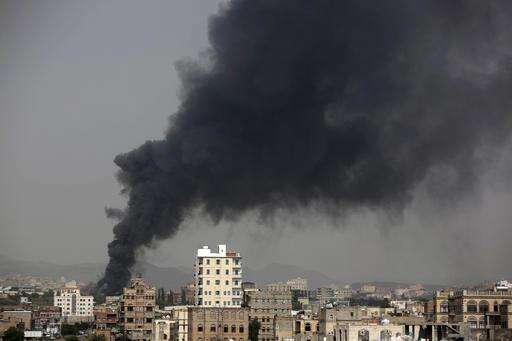
In this Aug. 9, 2016 photo, smoke rises after Saudi-led airstrikes hit a food factory in Sanaa, Yemen. In the air campaign by Saudi Arabia and its allies against Yemenâs Shiite rebels, rights experts say there has been a pattern by the Saudi-led coalition in depending on faulty intelligence, failing to distinguish between civilian and military targets and disregarding the likelihood of civilian casualties. Experts say some of the strikes likely amount to war crimes. (AP Photo/Hani Mohammed)
The Associated Press
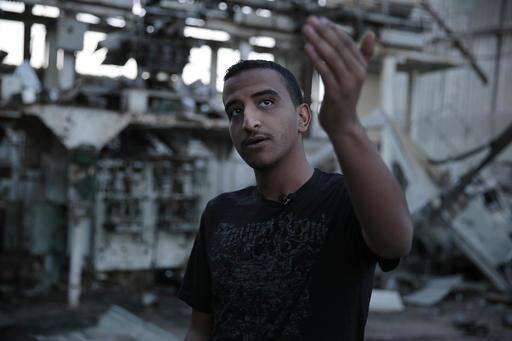
In this Oct. 4, 2016 photo, factory manager, Mustafa Elaghil gives an interview to The Associated Press, in Sanaa, Yemen. In the air campaign by Saudi Arabia and its allies against Yemenâs Shiite rebels, rights experts say there has been a pattern by the Saudi-led coalition in depending on faulty intelligence, failing to distinguish between civilian and military targets and disregarding the likelihood of civilian casualties. Experts say some of the strikes likely amount to war crimes. (AP Photo/Hani Mohammed)
The Associated Press
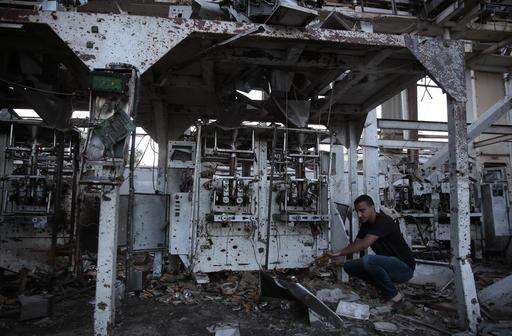
In this Oct. 4, 2016 photo, factory manager, Mustafa Elaghil, inspects a food factory that was hit by Saudi-led airstrikes, in Sanaa, Yemen. In the air campaign by Saudi Arabia and its allies against Yemenâs Shiite rebels, rights experts say there has been a pattern by the Saudi-led coalition in depending on faulty intelligence, failing to distinguish between civilian and military targets and disregarding the likelihood of civilian casualties. Experts say some of the strikes likely amount to war crimes. (AP Photo/Hani Mohammed)
The Associated Press
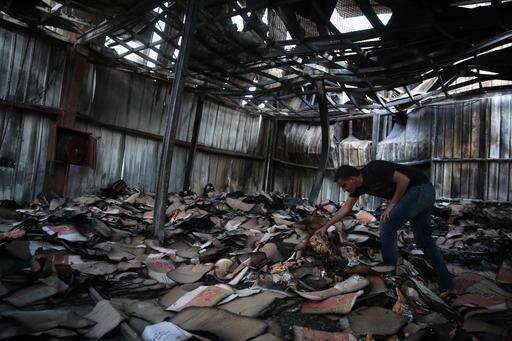
In this, Oct. 4, 2016 photo, factory manager, Mustafa Elaghil, inspects a food factory hit by Saudi-led airstrikes, in Sanaa, Yemen. In the air campaign by Saudi Arabia and its allies against Yemenâs Shiite rebels, rights experts say there has been a pattern by the Saudi-led coalition in depending on faulty intelligence, failing to distinguish between civilian and military targets and disregarding the likelihood of civilian casualties. Experts say some of the strikes likely amount to war crimes. (AP Photo/Hani Mohammed)
The Associated Press

In this Oct. 5, 2016 photo, a forensic expert examines the scene at Alsonidar Group's water pump and pipe factory after it was hit by Saudi-led airstrikes in Sanaa, Yemen. In the air campaign by Saudi Arabia and its allies against Yemenâs Shiite rebels, rights experts say there has been a pattern by the Saudi-led coalition in depending on faulty intelligence, failing to distinguish between civilian and military targets and disregarding the likelihood of civilian casualties. Experts say some of the strikes likely amount to war crimes. (AP Photo/Hani Mohammed)
The Associated Press
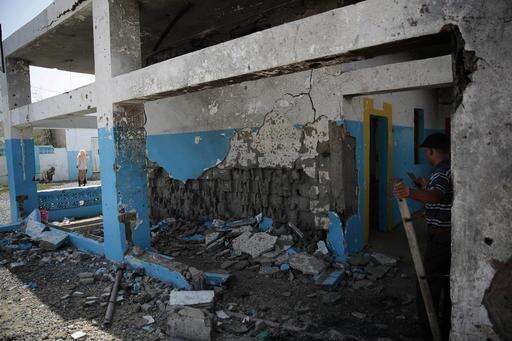
In this Oct. 6, 2016 photo, a man clears rubble at Abs hospital after it was hit by a Saudi-led airstrike, in the northern town of Abs, Yemen. In the air campaign by Saudi Arabia and its allies against Yemenâs Shiite rebels, rights experts say there has been a pattern by the Saudi-led coalition in depending on faulty intelligence, failing to distinguish between civilian and military targets and disregarding the likelihood of civilian casualties. Experts say some of the strikes likely amount to war crimes. (AP Photo/Hani Mohammed)
The Associated Press
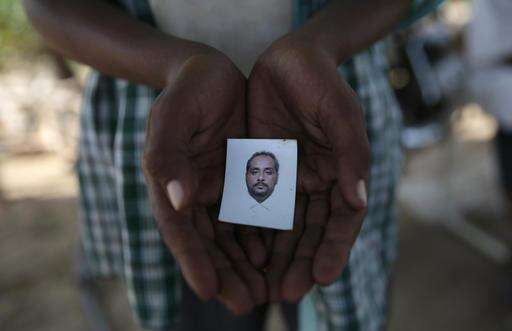
In this Oct. 7, 2016 photo, a man holds a picture of Mohammad Ali Hadish Khal who was killed by a Saudi-led airstrike that targeted his car at Abs hospital in August, in the northern town of Abs, Yemen. In the air campaign by Saudi Arabia and its allies against Yemenâs Shiite rebels, rights experts say there has been a pattern by the Saudi-led coalition in depending on faulty intelligence, failing to distinguish between civilian and military targets and disregarding the likelihood of civilian casualties. Experts say some of the strikes likely amount to war crimes. (AP Photo/Hani Mohammed)
The Associated Press
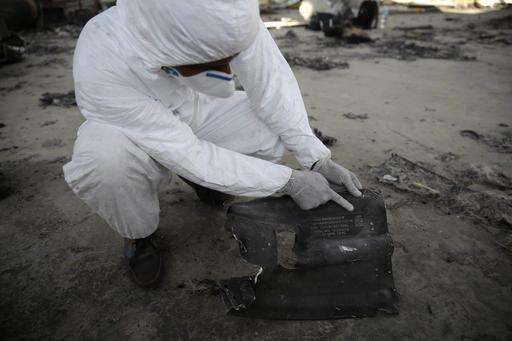
In this Oct. 5, 2016 photo, a forensic expert displays a fragment of a missile that destroyed Alsonidar Group's water pump and pipe factory by Saudi-led airstrikes in Sanaa, Yemen. In the air campaign by Saudi Arabia and its allies against Yemenâs Shiite rebels, rights experts say there has been a pattern by the Saudi-led coalition in depending on faulty intelligence, failing to distinguish between civilian and military targets and disregarding the likelihood of civilian casualties. Experts say some of the strikes likely amount to war crimes. (AP Photo/Hani Mohammed)
The Associated Press
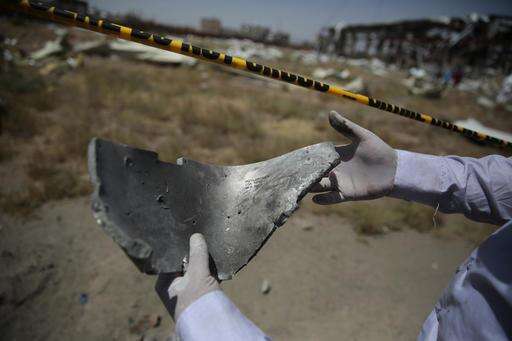
In this Oct. 5, 2016 photo, a forensic expert holds a fragment of a missile from a Saudi-led airstrike that destroyed Alsonidar Group's water pump and pipe factory in Sanaa, Yemen. In the air campaign by Saudi Arabia and its allies against Yemenâs Shiite rebels, rights experts say there has been a pattern by the Saudi-led coalition in depending on faulty intelligence, failing to distinguish between civilian and military targets and disregarding the likelihood of civilian casualties. Experts say some of the strikes likely amount to war crimes. (AP Photo/Hani Mohammed)
The Associated Press

In this Oct. 10, 2016 photo, bombs fragments, found in the rubble of a destroyed funeral hall that was struck by a deadly Saudi-led airstrike on Saturday, Oct. 8, 2016, are seen at a criminal lab in Sanaa, Yemen. In the air campaign by Saudi Arabia and its allies against Yemenâs Shiite rebels, rights experts say there has been a pattern by the Saudi-led coalition in depending on faulty intelligence, failing to distinguish between civilian and military targets and disregarding the likelihood of civilian casualties. Experts say some of the strikes likely amount to war crimes. (AP Photo/Hani Mohammed)
The Associated Press
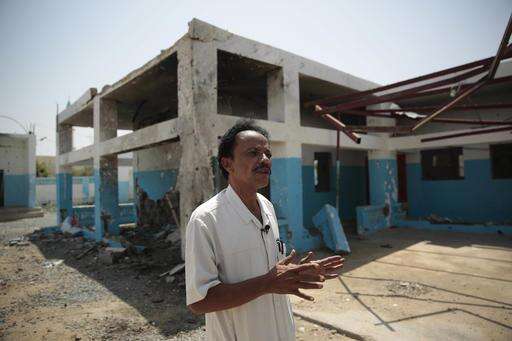
In this Oct. 6, 2016 photo, Ibrahim Ali, the director of Abs hospital gives an interview to The Associated Press, in the northern town of Abs, Yemen. In the air campaign by Saudi Arabia and its allies against Yemenâs Shiite rebels, rights experts say there has been a pattern by the Saudi-led coalition in depending on faulty intelligence, failing to distinguish between civilian and military targets and disregarding the likelihood of civilian casualties. Experts say some of the strikes likely amount to war crimes. (AP Photo/Hani Mohammed)
The Associated Press
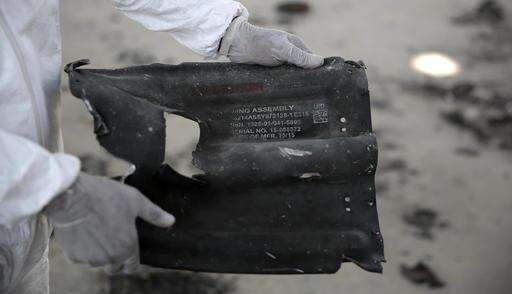
In this Oct. 5, 2016 photo, a forensic expert displays a fragment of a missile that destroyed Alsonidar Group's water pump and pipe factory by Saudi-led airstrikes in Sanaa, Yemen. In the air campaign by Saudi Arabia and its allies against Yemenâs Shiite rebels, rights experts say there has been a pattern by the Saudi-led coalition in depending on faulty intelligence, failing to distinguish between civilian and military targets and disregarding the likelihood of civilian casualties. Experts say some of the strikes likely amount to war crimes. (AP Photo/Hani Mohammed)
The Associated Press
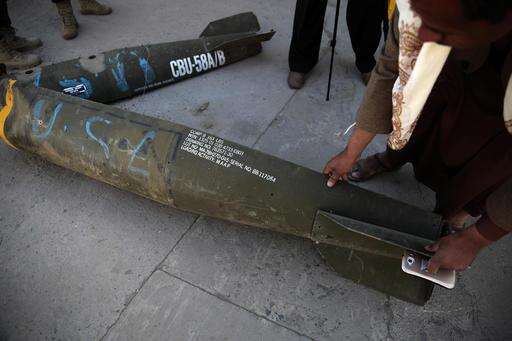
In this Oct. 5, 2016 photo, a Yemeni man displays an American-made CBU 58A/B, cluster bomb, in a police compound in Sanaa, Yemen. In the air campaign by Saudi Arabia and its allies against Yemenâs Shiite rebels, rights experts say there has been a pattern by the Saudi-led coalition in depending on faulty intelligence, failing to distinguish between civilian and military targets and disregarding the likelihood of civilian casualties. Experts say some of the strikes likely amount to war crimes. (AP Photo/Hani Mohammed)
The Associated Press
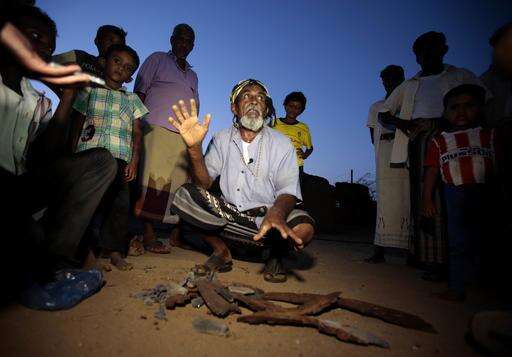
In this Oct. 6, 2016 photo, Shuai Mohammed Mghboul, displays fragments of a missile in the northern town of Abs, Yemen. In the air campaign by Saudi Arabia and its allies against Yemenâs Shiite rebels, rights experts say there has been a pattern by the Saudi-led coalition in depending on faulty intelligence, failing to distinguish between civilian and military targets and disregarding the likelihood of civilian casualties. Experts say some of the strikes likely amount to war crimes. (AP Photo/Hani Mohammed)
The Associated Press
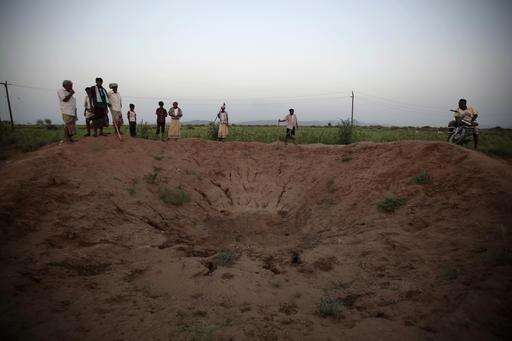
In this Oct. 6, 2016 photo, people stand around a hole made by a Saudi-led airstrike in the northern town of Abs, Yemen. In the air campaign by Saudi Arabia and its allies against Yemenâs Shiite rebels, rights experts say there has been a pattern by the Saudi-led coalition in depending on faulty intelligence, failing to distinguish between civilian and military targets and disregarding the likelihood of civilian casualties. Experts say some of the strikes likely amount to war crimes. (AP Photo/Hani Mohammed)
The Associated Press
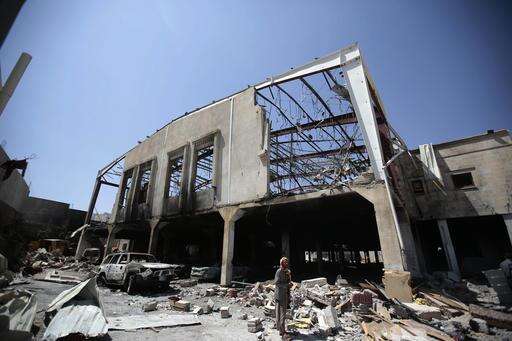
In this Oct. 13, 2016 photo, a Yemeni man stands in front of a funeral hall, destroyed by a deadly Saudi-led airstrike on Saturday, Oct. 8, 2016, in Sanaa, Yemen. In the air campaign by Saudi Arabia and its allies against Yemenâs Shiite rebels, rights experts say there has been a pattern by the Saudi-led coalition in depending on faulty intelligence, failing to distinguish between civilian and military targets and disregarding the likelihood of civilian casualties. Experts say some of the strikes likely amount to war crimes. (AP Photo/Hani Mohammed)
The Associated Press
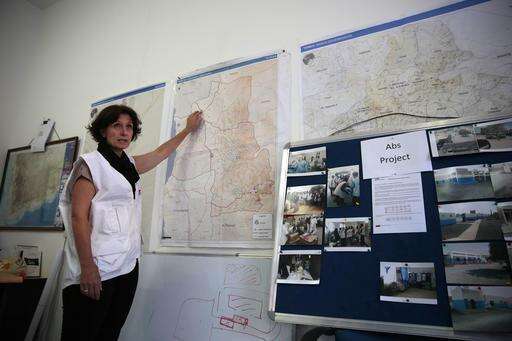
In this Oct. 4, 2016 photo, the head of Médecins Sans Frontières (MSF) mission, Colette Gadenne, points to a map during an interview with The Associated Press, at the MSF office in Sanaa, Yemen. In the air campaign by Saudi Arabia and its allies against Yemenâs Shiite rebels, rights experts say there has been a pattern by the Saudi-led coalition in depending on faulty intelligence, failing to distinguish between civilian and military targets and disregarding the likelihood of civilian casualties. Experts say some of the strikes likely amount to war crimes. (AP Photo/Hani Mohammed)
The Associated Press

In this Oct. 6, 2016 photo, a man stands near Abs hospital that was damaged by a Saudi-led airstrike, in the northern town of Abs, Yemen. In the air campaign by Saudi Arabia and its allies against Yemenâs Shiite rebels, rights experts say there has been a pattern by the Saudi-led coalition in depending on faulty intelligence, failing to distinguish between civilian and military targets and disregarding the likelihood of civilian casualties. Experts say some of the strikes likely amount to war crimes. (AP Photo/Hani Mohammed)
The Associated Press
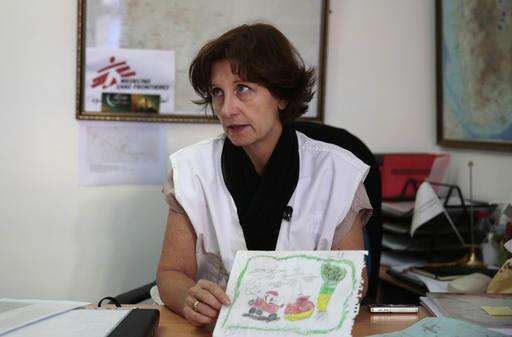
In this Oct. 4, 2016 photo, the head of the Médecins Sans Frontières (MSF) mission in Yemen, Colette Gadenne, points to a map during an interview with The Associated Press, at the MSF office in Sanaa, Yemen. In the air campaign by Saudi Arabia and its allies against Yemenâs Shiite rebels, rights experts say there has been a pattern by the Saudi-led coalition in depending on faulty intelligence, failing to distinguish between civilian and military targets and disregarding the likelihood of civilian casualties. Experts say some of the strikes likely amount to war crimes. (AP Photo/Hani Mohammed)
The Associated Press
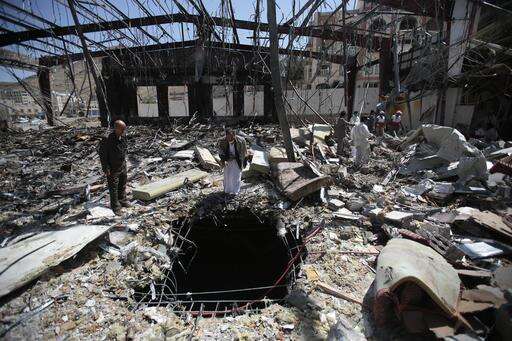
In this Oct. 13, 2016 photo, members of the Higher Council for Civilian Community Organization, inspect a destroyed funeral hall as they protest against the deadly Saudi-led airstrike on the hall, on Oct. 8, 2016, in Sanaa, Yemen. In the air campaign by Saudi Arabia and its allies against Yemenâs Shiite rebels, rights experts say there has been a pattern by the Saudi-led coalition in depending on faulty intelligence, failing to distinguish between civilian and military targets and disregarding the likelihood of civilian casualties. Experts say some of the strikes likely amount to war crimes. (AP Photo/Hani Mohammed)
The Associated Press
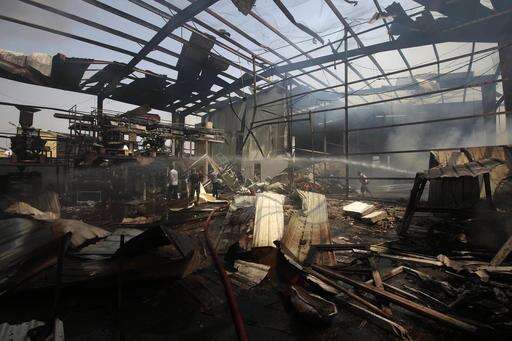
In this Aug. 9, 2016 photo, people work to extinguish fire at a food factory hit by Saudi-led airstrikes in Sanaa, Yemen. In the air campaign by Saudi Arabia and its allies against Yemenâs Shiite rebels, rights experts say there has been a pattern by the Saudi-led coalition in depending on faulty intelligence, failing to distinguish between civilian and military targets and disregarding the likelihood of civilian casualties. Experts say some of the strikes likely amount to war crimes. (AP Photo/Hani Mohammed)
The Associated Press
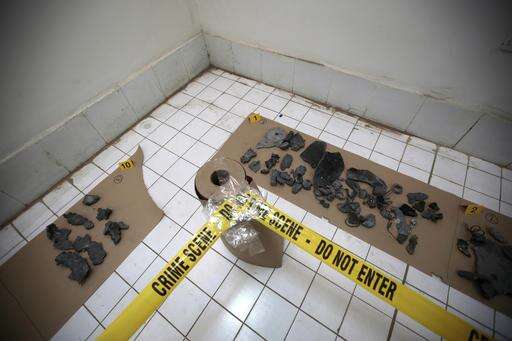
In this Oct. 10, 2016 photo, bombs fragments found in the rubble of a destroyed funeral hall that was struck by a deadly Saudi-led airstrike on Oct. 8, 2016, are laid out at a criminal lab in Sanaa, Yemen. In the air campaign by Saudi Arabia and its allies against Yemenâs Shiite rebels, rights experts say there has been a pattern by the Saudi-led coalition in depending on faulty intelligence, failing to distinguish between civilian and military targets and disregarding the likelihood of civilian casualties. Experts say some of the strikes likely amount to war crimes. (AP Photo/Hani Mohammed)
The Associated Press
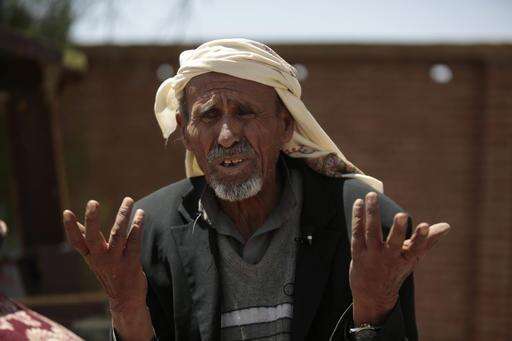
In this Oct. 5, 2016 photo, Massoud Abdullah Azzan, 75, who is a gatekeeper in Alsonidar Group's water pump and pipe factory, speaks to a reporter during an interview with the Associated Press in Sanaa, Yemen. In the air campaign by Saudi Arabia and its allies against Yemenâs Shiite rebels, rights experts say there has been a pattern by the Saudi-led coalition in depending on faulty intelligence, failing to distinguish between civilian and military targets and disregarding the likelihood of civilian casualties. Experts say some of the strikes likely amount to war crimes. (AP Photo/Hani Mohammed)
The Associated Press