Protesters display their message during a rally outside of the Chinese Consulate hours before the Hague-based UN international arbitration tribunal is to announce its ruling on South China Sea Tuesday, July 12, 2016, in Makati city east of Manila, Philippines. The protesters are urging China to respect the Philippines' rights over its exclusive economic zone and extended continental shelf as mandated by the UN Convention of the Law of the Sea or UNCLOS. (AP Photo/Bullit Marquez)
The Associated Press
THE HAGUE, Netherlands (AP) - A tribunal ruled in a sweeping decision Tuesday that China has no legal basis for its extensive claims in the South China Sea and had aggravated the seething regional dispute with its large-scale land reclamation and construction of artificial islands that destroyed coral reefs and the natural condition of the disputed areas.
China immediately rejected the findings, and their impact remained unclear as there is no policing agency or mechanism to enforce them.
Ruling on a variety of disputes the Philippines had asked the tribunal to settle, the five-member panel unanimously concluded that China had violated its obligations to refrain from aggravating the dispute while the settlement process was ongoing. It also found that China had interfered with Philippine petroleum exploration at Reed Bank, tried to stop fishing by Philippine vessels within the country's exclusive economic zone and failed to prevent Chinese fishermen from fishing within the Philippines' exclusive economic zone at Mischief Reef and Second Thomas Shoal.
Philippine Foreign Secretary Perfecto Yasay welcomed the decision, and pledged to pursue a peaceful resolution of his country's territorial disputes with China.
"The Philippines strongly affirms its respect for this milestone decision as an important contribution to ongoing efforts in addressing disputes in the South China Sea," he said in Manila.
China reiterated that it does not accept the panel's jurisdiction. China "solemnly declares that the award is null and void and has no binding force. China neither accepts nor recognizes it," the foreign ministry's statement said.
It added that "China's territorial sovereignty and maritime rights and interests in the South China Sea shall under no circumstances be affected by those awards." The ministry repeated China's often-expressed stance that the Philippines' move to initiate arbitration without China's consent was in "bad faith" and in violation of international law.
A professor of Asian political economy said the ruling could be a "transformative moment" in the region.
Speaking outside the Peace Palace in The Hague, Leiden University professor Jonathan London said the decision will "give countries with a common interest in international norms something to point to and to rally around."
He said they can say to China: "Look, here are the results of an international organization that has found that your claims have zero historical basis."
Japan's Foreign Minister Fumio Kishida said the tribunal's decision is "final and legally binding" and that the two sides should comply with it. He said in a statement that "Japan strongly expects that the parties' compliance with this award will eventually lead to the peaceful settlement of disputes in the South China Sea."
China says that bilateral talks between Beijing and other claimants is the only way to address the South China Sea disputes.
The tribunal said that any historic rights to resources that China may have had were wiped out if they are incompatible with exclusive economic zones established under a U.N. treaty that both countries have signed and which came into effect in 1994.
It also criticized China for building a large artificial island on Mischief Reef, saying it caused "permanent irreparable harm" to the coral reef ecosystem and permanently destroyed evidence of the natural conditions of the feature.
China drafted its so-called nine-dash line to demarcate its claims to virtually the entire South China Sea. Manila brought the case because China's claims infringe upon its own 200-mile exclusive economic zone.
The dispute centers on waters through which an estimated $5 trillion in global trade passes through each year and are home to rich fishing stocks and a potential wealth of oil, gas and other resources. The ruling comes as the U.S. has ramped up its military presence in the region.
However a new Philippine leader who appears friendlier to Beijing could also influence the aftermath of the ruling.
Dozens of rallying Filipinos jumped for joy, wept, embraced each other and waved Philippine flags after news of the sweeping victory broke out. One held up a poster that said: "Philippine sovereignty, non-negotiable."
Vietnam, meanwhile, accused Chinese vessels of sinking a Vietnamese fishing boat in disputed waters. Nguyen Thanh Hung, a local fisheries executive in the central province of Quang Ngai, said two Chinese vessels chased and sank the Vietnamese boat around midday Saturday as it was fishing near the Paracel islands. The five fishermen were rescued by another trawler around seven hours later.
___
Gomez reported from Manila, Philippines. Associated Press writers Gillian Wong in Beijing, Mari Yamaguchi in Tokyo and Vijay Joshi in Bangkok contributed to this report.
In this July 7, 2015, image provided by the Permanent Court of Arbitration, the case regarding the Philippines and China on the South China Sea is heard at the Permanent Court of Arbitration (PCA) at The Hague, the Netherlands. An arbitration panel in The Hague, Netherlands, will issue a ruling Tuesday, July 12, 2016, in a long-running dispute between the Philippines and China over the South China Sea. The Philippines has asked the tribunal to declare China's claims and actions invalid under the U.N. Convention on the Law of the Sea. Beijing has refused to join the case, rejecting the tribunal's jurisdiction, and says it will not accept the decision.(Permanent Court of Arbitration via AP)
The Associated Press

Protesters shout slogans as they march outside of the Chinese Consulate hours before the Hague-based UN international arbitration tribunal is to announce its ruling on South China Sea Tuesday, July 12, 2016, in Makati city east of Manila, Philippines. The protesters are urging China to respect the Philippines' rights over its exclusive economic zone and extended continental shelf as mandated by the UN Convention of the Law of the Sea or UNCLOS. (AP Photo/Bullit Marquez)
The Associated Press
Protesters display placards during a rally outside of the Chinese Consulate hours before the Hague-based UN international arbitration tribunal is to announce its ruling on South China Sea Tuesday, July 12, 2016, in Makati city east of Manila, Philippines. The protesters are urging China to respect the Philippines' rights over its exclusive economic zone and extended continental shelf as mandated by the UN Convention of the Law of the Sea or UNCLOS. (AP Photo/Bullit Marquez)
The Associated Press
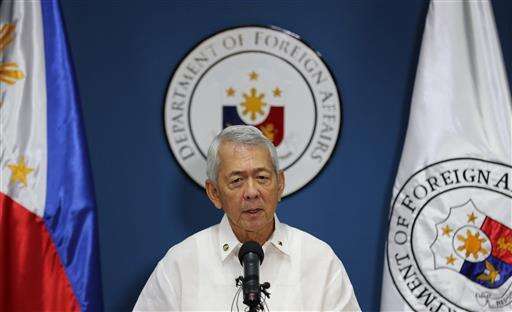
Philippines Foreign Affairs Secretary Perfecto Yasay Jr. issues a statement on the recent ruling in a long-running dispute between the Philippines and China over the South China Sea during a press conference in suburban Pasay, south of Manila, Philippines on Tuesday, July 12, 2016. An international tribunal has found that there is no legal basis for China's "nine-dash line" claiming rights to much of the South China Sea. The tribunal issued its ruling Tuesday in The Hague in response to an arbitration case brought by the Philippines against China. (AP Photo/Aaron Favila)
The Associated Press
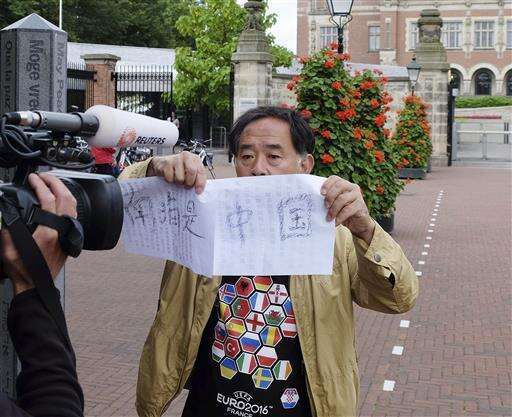
A man holds up a handwritten sign in Chinese which says "South Sea belongs to China", in reference to the South China Sea, outside the Peace Palace in The Hague, Netherlands, on Tuesday, July 12, 2016, ahead of a ruling by the Permanent Court of Arbitration (PCA) on the dispute between China and the Philippines over the South China Sea. China has intensified the drumbeat of its opposition to an international tribunal's ruling expected Tuesday that could threaten its expansive claims in the South China Sea. (AP Photo/Mike Corder)
The Associated Press
In this photo taken March 29, 2014, a Philippine flag flutters from the deck of the Philippine Navy ship LT 57 Sierra Madre off Second Thomas Shoal in the South China Sea. China has intensified the drumbeat of its opposition to a milestone ruling expected Tuesday, July 12, 2016, by an international tribunal that could threaten its expansive claims in the South China Sea.(AP Photo/Bullit Marquez)
The Associated Press
FILE - In this Oct. 27, 2015, file photo, provided by Filipino fisherman Renato Etac, a Chinese Coast Guard boat circles a Filipino fishing boat near Scarborough Shoal in the South China Sea. China has intensified the drumbeat of its opposition to a milestone ruling expected Tuesday July 12, 2016, by an international tribunal that could threaten its expansive claims in the South China Sea. (Renato Etac via AP, File )
The Associated Press
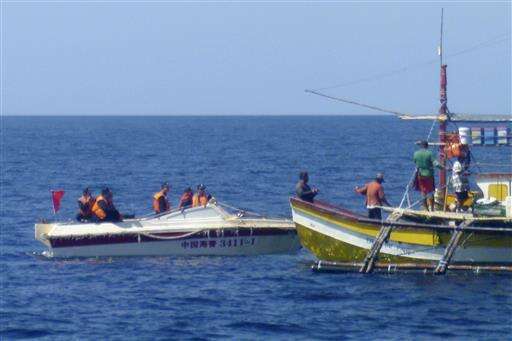
In this Feb. 27, 2015, photo, provided by Filipino fisherman Renato Etac, Chinese Coast Guard members approach Filipino fishermen near Scarborough Shoal in the South China Sea. An international tribunal has found that there is no legal basis for China's claiming rights to much of the South China Sea. The Permanent Court of Arbitration (PCA) issued its ruling Tuesday, July 12, 2016, in The Hague in response to an arbitration case brought by the Philippines against China regarding the South China Sea, saying that any historic rights to resources that China may have had were wiped out if they are incompatible with exclusive economic zones established under a U.N. treaty. (Renato Etac via AP)
The Associated Press
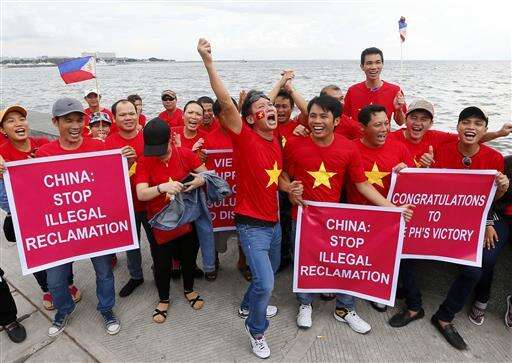
Vietnamese expatriates cheer while displaying placards during a rally by the Manila's baywalk before the Hague-based U.N. international arbitration tribunal is to announce its ruling on South China Sea Tuesday, July 12, 2016, Philippines. The Vietnamese are supporting the Philippines' case it filed before the international tribunal on China's nine-dash line claim in the South China Sea. (AP Photo/Bullit Marquez)
The Associated Press