In this Friday, March 11, 2016 photo, a UN guard post is seen through the barbed wires at the United Nations controlled area between the Greek south and the Turkish Cypriot north controlled areas at the divided capital Nicosia, Cyprus. Tiny Cyprus heads into this weekâs European Union-Turkey summit facing intense pressure to unblock rival Turkeyâs EU membership talks and pave the way for a crucial deal to control the inflow of migrants and preserve the fractured blocâs unity. But the stakes are high for the ethnically-split island nation too; giving in without clinching substantial trade-offs could undermine reunification talks with breakaway Turkish Cypriots and damage the presidency of Nicos Anastasiades. (AP Photo/Petros Karadjias)
The Associated Press
NICOSIA, Cyprus (AP) - European Union leaders seek a mutually binding deal with Turkey to stem the flow of migrants by sea to Greece. But several nations stand in the way of such a pact - and tiny Cyprus could pose the greatest diplomatic challenge of all.
Leaders of the EU's 28 divided nations plan to reconvene in Brussels this week in hopes of ironing out disagreements on a proposed agreement with Turkey. Their tentative agreement struck March 7 would allow Greece to return migrants to Turkey as Europe opens new routes for pre-screened migrants to seek asylum legally.
But Turkey demands big concessions from Europe in return, particularly on its long-held dream of joining the EU, an idea viewed with trepidation by many Europeans. Nowhere does mistrust run higher than in neighboring Cyprus, which has been divided into a Greek Cypriot south and militarized Turkish Cypriot north since 1974.
Cyprus announced Tuesday it has no intention of permitting full negotiations for Turkey's EU membership - a position that could scuttle the whole deal. Each EU member must consent to any deal.
European Council President Donald Tusk arrived in the Cypriot capital, Nicosia, seeking to soothe government nerves over a proposed package that would include renewed negotiations on Turkish EU membership.
Cyprus President Nicos Anastasiades told Tusk his government would not concede on this key point. He called EU pressure seeking Cypriot acquiescence on the matter "unwarranted, counterproductive and not to mention unacceptable."
Those seeking a deal hope to end the humanitarian crisis on Greece's closed northern border with non-EU member Macedonia, where hundreds of thousands crossed last year but many thousands today remain stuck, often in squalid camps, their progress north blocked by barbed wire and club-wielding police.
Negotiators fear that permitting another year of poorly controlled mass migration could undermine the EU's own free movement of citizens and goods and trigger a rise in political extremism already being felt in many countries.
Indeed, diplomats of several EU countries express their own private reservations about Turkey's ability to deliver its end of the agreement - and question other parts of what the Turks seek in return, particularly visa-free travel for its more than 75 million citizens within the bloc.
An expert on the migration crisis based in Athens, Apostolis Fotiadis, said German Chancellor Angela Merkel and others seeking an EU-Turkey agreement must "convince too many people."
He said Cyprus would likely drop its veto if Turkey granted it diplomatic recognition, a commitment refused despite Cyprus' international recognition and 2004 admission to the EU.
Turkey maintains 35,000 troops in the north, with the island's capital divided down the middle.
Fotiadis said more hurdles lurked in other European capitals, with EU heavyweight France concerned about granting Turks freer travel in Europe and many expressing doubts that some proposals were even legal.
Kenneth Roth, executive director of Human Rights Watch, wrote to EU leaders Tuesday arguing that that three planks of proposals - to permit summary deportations from Greece, to impose quotas on Europe-bound asylum seekers, and to create a supposed "safe zone" within Syria that would allow Turkey to refuse entry to refugees - were all "legally, morally and politically wrong."
He said if government sanctioned those moves, it "would signal a stark repudiation of international law and the very values on which the European Union was founded."
Those currently stranded in Greece express worries that any new EU-Turkey agreement would render their expensive, grueling efforts to reach Western Europe futile.
More than 8,500 newcomers sailed last week from Turkey to nearby Greek islands despite the Balkan gridlock.
Some 1,500 people stranded in northern Greece staged a dramatic effort Monday to breach border security and reach Macedonia. They carried children and belongings as they waded across a river to seek a break in the fence along the rugged 235-kilometer (145-mile) frontier.
Macedonian police and soldiers caught most and sent them back Tuesday. Some of those forced back told The Associated Press they had been beaten and attacked with Tasers. Macedonia rejected this.
One of the thousands of blocked Syrians, Abdul Mahammad, said he felt that Europe was telling him that the muddy fields of northern Greece must be his new home.
"You feel that your dream is broken," he said. "You can't go to finish your trip, to have work, to have a good life."
___
Gatopoulos reported from Athens. Associated Press reporters Nicholas Paphitis in Athens; Konstantin Testorides in Skopje, Macedonia; and Costas Kantouris, Amer Cohadzic and Mstyslav Chernov in Idomeni, Greece, contributed to this report.
___
Follow Hadjicostis at http://www.twitter.com/MenHad and Gatopoulos at http://www.twitter.com/dgatopoulos
A Syrian man carries a child as migrants and refugees who just arrived with a ferry from Greek island prepare to get on busses with destination a transit camp at the port of Piraeus near Athens, on Tuesday, March 15, 2016. The government says nearly 44,000 people are stranded in Greece following border restrictions and closures by Austria and several Balkan countries.(AP Photo/Petros Giannakouris)
The Associated Press
A woman pose on a dock at the port of Piraeus where some 4000 refugees and migrants are temporary hosted, on Tuesday, March 15, 2016. The government says nearly 44,000 people are stranded in Greece following border restrictions and closures by Austria and several Balkan countries.(AP Photo/Petros Giannakouris)
The Associated Press
Child's clothing is placed on old railway tracks to dry, as migrants strive to cope with their own plight and it continues to rain at the northern Greek border point of Idomeni, Greece, Tuesday, March 15, 2016. Some hundreds of migrants walked out Monday of an overcrowded camp on the Greek-Macedonian border Monday, in an effort to circumnavigate border controls and travel north toward central Europe, but were returned to Greece. (AP Photo/Vadim Ghirda)
The Associated Press
Migrants walk on a road after they were turned back from Macedonia, north of Idomeni, Greece, Tuesday, March 15, 2016. Some hundreds of migrants walked out Monday of an overcrowded camp on the Greek-Macedonian border Monday, in an effort to circumnavigate border controls and travel north toward central Europe, but were returned to Greece. (AP Photo/Vadim Ghirda)
The Associated Press
A migrant girl looks out from a bus window streaked with rain, north of Idomeni, Greece, Tuesday, March 15, 2016. Some hundreds of migrants walked out Monday of an overcrowded camp on the Greek-Macedonian border Monday, in an effort to circumnavigate border controls and travel north toward central Europe, but were returned to Greece. (AP Photo/Vadim Ghirda)
The Associated Press
A migrant leans on a baby stroller loaded with belongings while others sit on the road after they were turned back from Macedonia, north of Idomeni, Greece, Tuesday, March 15, 2016. Some hundreds of migrants walked out Monday of an overcrowded camp on the Greek-Macedonian border Monday, in an effort to circumnavigate border controls and travel north toward central Europe, but were returned to Greece. (AP Photo/Vadim Ghirda)
The Associated Press
A migrant carries a baby on the road after they were turned back from Macedonia, north of Idomeni, Greece, Tuesday, March 15, 2016. Hundreds of migrants and refugees walked out Monday of an overcrowded camp on the Greek-Macedonian border Monday, determined to use a dangerous crossing to head north but were returned to Greece.(AP Photo/Vadim Ghirda)
The Associated Press
Migrants get a ride in a Greek villager's truck up a muddy road after they were turned back from Macedonia, north of Idomeni, Greece, Tuesday, March 15, 2016. Hundreds of migrants and refugees walked out Monday of an overcrowded camp on the Greek-Macedonian border Monday, determined to use a dangerous crossing to head north but were returned to Greece.(AP Photo/Vadim Ghirda)
The Associated Press
European Council President Donald Tusk, left, talks with Cyprus President Nicos Anastasiades at the Presidential Palace before their meeting in the ethnically divided island's capital Nicosia on Tuesday, March 15, 2016. Tusk is in Cyprus to sound out the Cypriot president on unblocking Turkey's EU accession negotiations in order to clinch a sought-after deal with Ankara on stemming the flow of migrants into the continent. (AP Photo/Petros Karadjias)
The Associated Press
Migrants sit under a plastic sheet after they were turned back from Macedonia, north of Idomeni, Greece, Tuesday, March 15, 2016. Hundreds of migrants and refugees walked out Monday of an overcrowded camp on the Greek-Macedonian border Monday, determined to use a dangerous crossing to head north but were returned to Greece.(AP Photo/Vadim Ghirda)
The Associated Press
Macedonian army armored vehicle patrols between two-line fence, along the border line between Macedonia and Greece, near southern Macedonia's town of Gevgelija, Tuesday, March 15, 2016. Hundreds of migrants and refugees walked out of an overcrowded camp on the Greek-Macedonian border Monday, determined to use a dangerous crossing to head north. (AP Photo/Boris Grdanoski)
The Associated Press
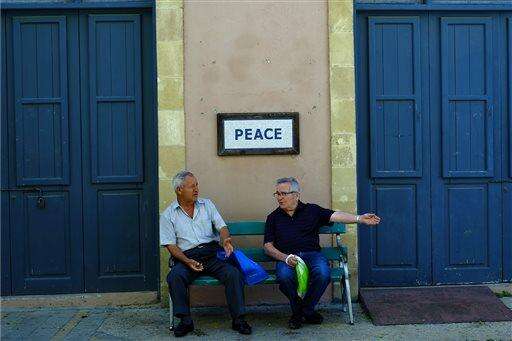
In this Thursday, March 10, 2016 photo, two men sit on a bench and talk as a sign read "Peace" near the Ledras checkpoint in divided capital Nicosia, Cyprus. Tiny Cyprus heads into this weekâs European Union-Turkey summit facing intense pressure to unblock rival Turkeyâs EU membership talks and pave the way for a crucial deal to control the inflow of migrants and preserve the fractured blocâs unity. But the stakes are high for the ethnically-split island nation too; giving in without clinching substantial trade-offs could undermine reunification talks with breakaway Turkish Cypriots and damage the presidency of Nicos Anastasiades. (AP Photo/Petros Karadjias)
The Associated Press